
How half the dose is doing something nobody expected and why millions of people are finally admitting the thing they never said out loud.
I really appreciate you checking out my blog! Just so you know, some of the links in this post are affiliate links. This means that if you buy something through them, I might earn a little bit of money, at no extra cost to you. There’s absolutely no pressure to buy anything, but if you do, it genuinely helps support the time and love I put into writing these posts.
Let me tell you the sentence that stopped me cold.
A woman I know, smart, funny, zero drama, was talking about her week and halfway through a totally normal story she just paused and said: “I just realized I haven’t argued with myself about food. Not once. All day.”
And then she laughed like she couldn’t believe that was even a thing to say.
But here’s what happened in that moment: every single person at the table went quiet.
Because we all knew exactly what she meant.
There is a conversation that runs in millions of people heads every single day. Not out loud. Never out loud. Just this low, grinding background noise that sounds something like:
I shouldn’t.
I already messed up.
I’ll start Monday.
I deserve this.
I don’t deserve this.
I’ll be better tomorrow.
Tomorrow. Tomorrow. Tomorrow.
It’s not a food problem. It’s a mental real estate problem. And it never, ever stops.
Until, apparently, it does.
Something very quiet, and very strange, is happening right now.
Not on TikTok (well, okay, a little on TikTok). But mostly in group chats. In whispered conversations at girls’ dinners. In offhand comments from the person at Costco who used to buy three bags of chips and now just… doesn’t.
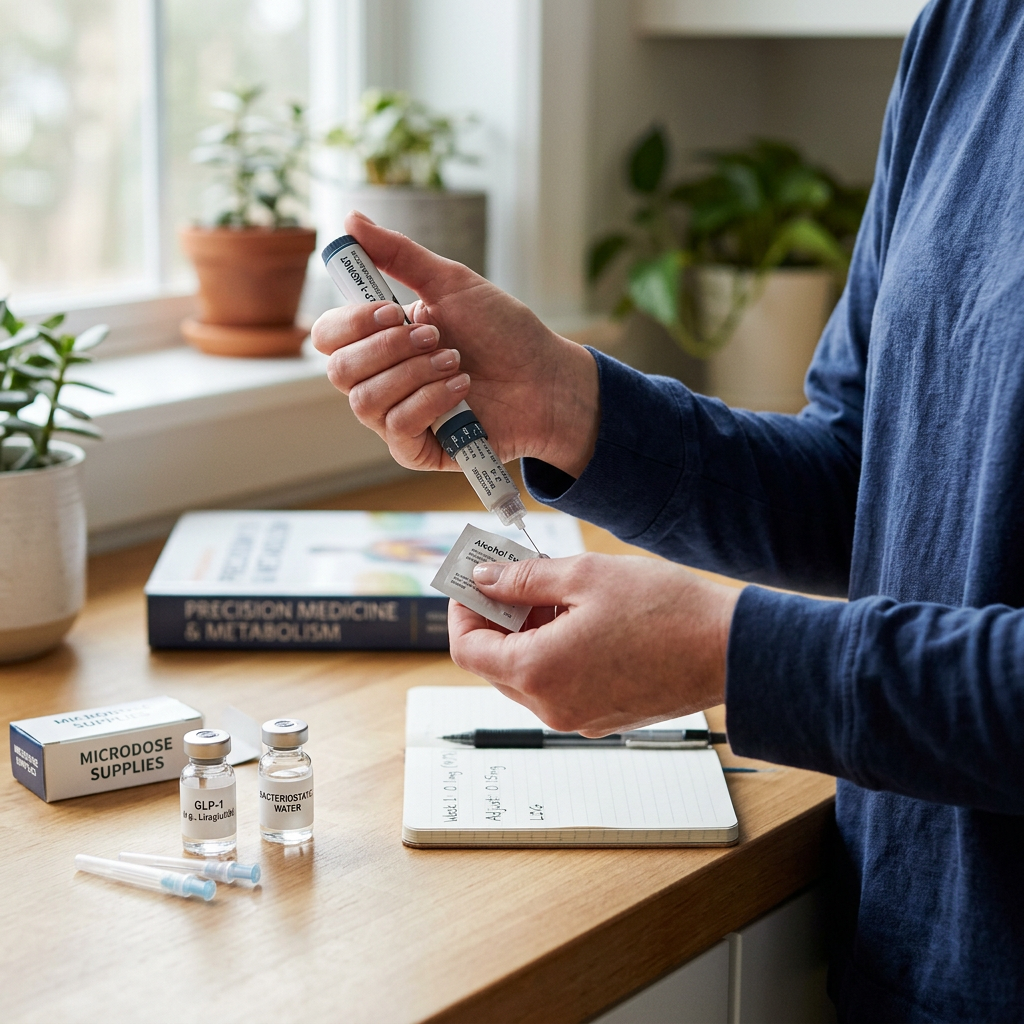
People are microdosing GLP-1s.
Not the dramatic full-dose, “I lost 80 pounds and my whole personality changed” version you saw everywhere in 2024.
Tiny doses. Half doses. Just enough.
Just enough to turn the volume down.
And the part that nobody saw coming?
It’s not mostly about weight loss anymore.
I want you to sit with this for a second, because I think it’s the most underreported thing happening in the wellness culture right now.
People are microdosing because they want mental quiet.
Not abs. Not a new body. Not before-and-after photos for the internet.
They want to walk into a kitchen and not feel ambushed by their own brain.
They want to go to a work event and eat two hors d’oeuvres like a normal adult instead of either inhaling everything in sight or white-knuckling it in the corner.
They want to stop lying in bed replaying every food decision they made that day like it was a courtroom drama.
One woman described it as: “It felt like someone turned off a TV that had been on in the background my entire life.”
I think about that sentence constantly.
Here’s the thing about the food that nobody wants to say directly:
We built a whole emotional infrastructure around eating.
Stress snacks. Reward treats. Comfort carbs. Boredom browsing in the fridge at 10pm not because you’re hungry but because you are TIRED and overstimulated and your nervous system needs somewhere to go.
We open the fridge the same way we open Instagram — not for sustenance, but for something to do with the feeling.
Microdosing GLP-1s, for a lot of people, is the first time they’ve ever interrupted that loop.
Not because they have more willpower.
Not because they suddenly love broccoli.
But because the loop just… slows down. Quiets. And in that quiet, there’s space to actually notice what was happening.
That is not a small thing.
The cultural shift is real and it’s moving fast.
In 2022, people whispered about weight-loss medication like they were admitting something shameful. In 2026, people compare doses in the group chat the same way they compare cold brew orders.
The stigma didn’t just shrink. It nearly collapsed.
And what replaced it is this fascinating new conversation, less about shrinking, more about reclaiming.
Less: I need to be smaller.
More: I need my brain back.
Less: I want to look different.
More: I want to feel different inside my own day.
That reframe matters enormously, because it changes who this conversation includes.
It’s not just people with significant weight to lose. It’s people who feel controlled by food in ways that don’t show up in their clothing size. People whose relationship with eating is exhausting even when it’s invisible to everyone else.
Now here’s where it gets genuinely interesting, and a little surprising.
People microdosing are reporting changes that have nothing to do with what they eat.
Less impulsive spending.
Less late-night doom scrolling.
Less drinking, without even trying.
Which, if you follow the science even casually, makes a lot of sense.
GLP-1 receptors don’t only live in your stomach. They live in your brain. Specifically in the reward and impulse centers.
Which means what’s being quieted isn’t just appetite.
It’s the whole more more more loop.
The part of you that reaches for something when you’re overstimulated. When you’re bored. When you need a hit of something easy to get through a hard afternoon.
For some people, microdosing is the first time they’ve experienced what it’s like when that loop isn’t running the show.
And they describe it, almost universally, as feeling normal.
Not perfect. Not disciplined. Not “on track.”
Just. Normal.
I want to be careful here, because this isn’t a piece about telling you what to do.
Microdosing GLP-1s isn’t magic. It doesn’t fix emotional eating, it just creates enough space to finally see it. It has side effects. It has costs. It has a whole medical context that matters.
And honestly, it’s not for everyone, and it doesn’t need to be.
But what I think IS for everyone, what I think is deeply important for people to talk about right now, is the thing underneath it.
The exhaustion.
The years of all-or-nothing diet cycles that left people feeling broken.
The wellness industry that sold “discipline” as a personality trait instead of a privilege.
The way food became simultaneously the problem and the solution.
The shame that never quite goes away.
People aren’t flocking to microdosing because they’re lazy or looking for shortcuts.
They’re doing it because they are tired.
And for the first time in a very long time, they found something that made the tired quieter.
That’s the real story.
So here’s what I keep coming back to.
If millions of people are choosing “mental quiet” over “dramatic transformation” what does that tell us about where we actually are right now?
I think it tells us that people are done performing wellness.
Done with the before-and-afters.
Done with the 75 Hard challenges that end in secret shame.
Done with the identity overhaul that requires you to become a completely different person by February.
What people want now is simpler and, honestly, harder to sell:
They want to feel okay inside their own head.
Not incredible. Not optimized. Not transformed.
Just. Okay.
And maybe that’s not a small ask.
Maybe that’s the whole thing.
I write about this stuff, the real, messy, unsexy underbelly of wellness culture, because I think we deserve conversations that don’t make us feel worse about ourselves halfway through.
If this landed somewhere real for you, I’d love to know. Drop a comment. Tell me where your brain went while you were reading. The most interesting thing about all of this isn’t the medication, it’s what people are finally admitting out loud.
And if you want more pieces like this, honest, curious, zero toxic positivity, come find me on Substack. I write there every week, and I save the best stuff for subscribers.
See you there.
Disclosure: As an Amazon Associate, I may earn from qualifying purchases, but this does not affect my recommendations.I only suggest products I’ve personally vetted.


Leave a Reply