
The slow shrinking nobody warns you about and three things that helped me start feeling like myself again
I really appreciate you checking out my blog! Just so you know, some of the links in this post are affiliate links. This means that if you buy something through them, I might earn a little bit of money, at no extra cost to you. There’s absolutely no pressure to buy anything, but if you do, it genuinely helps support the time and love I put into writing these posts.
There’s a version of you that used to want things.
Not in a vague, vision-board way. In a real, physical, chest-expanding way. You had ideas that made you impatient. You had opinions you couldn’t wait to say out loud. You had this low hum of aliveness that followed you around, this sense that your life was building toward something and you were genuinely curious to find out what.
And then somewhere between the last two years and right now, that hum got quieter.
You didn’t notice it leaving. That’s the thing. It didn’t happen dramatically. There was no breakdown, no crisis, no obvious moment you could point to. Just a gradual, almost polite withdrawal. Like a guest who stopped coming around without ever officially saying goodbye.
Now you scroll. You work. You do the things. You’re fine, everyone would tell you you’re fine, but somewhere underneath the fine is this uncomfortable awareness that you’re living slightly outside yourself. Going through motions that used to feel like choices. Checking off days instead of inhabiting them.
That’s not burnout. Burnout is loud. This is something quieter and in some ways harder to fix because you can barely name it.
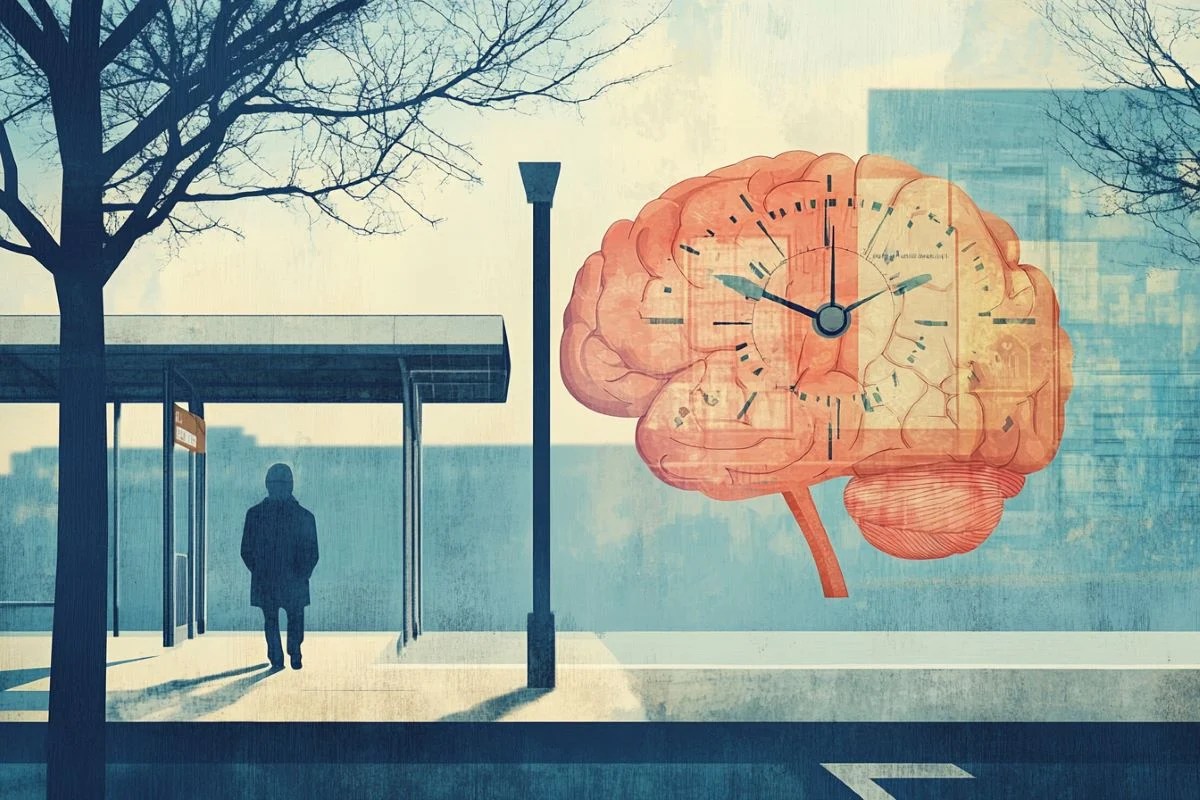
Psychologists call it emotional narrowing. The slow reduction of your interior life under chronic, low-grade stress. You stop following curiosity because curiosity requires energy you’re quietly rationing. You stop taking risks because your nervous system is already running at capacity just managing the ordinary. You stop feeling the edges of your own personality, the sharp parts, the weird parts, the parts that made you interesting to yourself.
And the world keeps moving, and you keep performing, and almost nobody notices. Including you. Until one day you’re sitting somewhere ordinary, a Tuesday morning, a parking lot, a shower, and you think: when did I get so small?
What’s Actually Happening Inside Your Body
Here’s the part that changed everything for me when I finally understood it.
This isn’t a mindset problem. It isn’t a discipline problem. It isn’t even really a mental health problem in the clinical sense. It’s a chemistry problem. Specifically, it’s a cortisol problem.
When your nervous system is under sustained stress, and I mean the low-grade, invisible, chronic kind, not the acute crisis kind, your brain gradually reallocates resources. It pulls energy away from the prefrontal cortex, which is where your creativity, your curiosity, your sense of future possibility all live, and redirects it toward threat monitoring. Toward survival.
Which means the longer you live in a mildly overwhelming environment, the more your brain physically loses access to the parts of itself that make life feel worth showing up for.
You’re not lazy. You’re not ungrateful. You’re not broken.
Your brain is doing exactly what brains do under exactly these conditions. It’s protecting you by making you smaller.
The question is just whether you’re okay with staying that way.
I Stopped Trying to Think My Way Out
I spent a long time trying to fix this with the same brain that was causing the problem. More reflection. More journaling prompts about my “core values.” More podcasts about getting your life together from people whose lives appeared to already be together.
None of it touched the thing underneath.
What finally moved the needle wasn’t a mindset shift. It was changing the actual physical chemistry of my days. Three things specifically. And I want to be straight with you, none of them are glamorous. None of them went viral. None of them will make your apartment look more aesthetic on Instagram.
But they gave me back something I hadn’t realized I was missing until it came back.
The Mineral That Was Missing From Everything
The first thing was magnesium.
Specifically magnesium glycinate, the form your body actually absorbs rather than flushes straight out. I started taking Thorne Magnesium Bisglycinate at night, and I want to tell you this with full awareness of how it sounds: within two weeks, I felt chemically different. Not high. Not sedated. Just less braced.
Here’s what most people don’t know: studies suggest the majority of Americans are deficient in magnesium, and magnesium is the mineral most directly involved in your nervous system’s ability to downshift out of stress response. It regulates cortisol. It governs the part of your brain that decides whether it’s safe to relax.
If you are chronically depleted in it, which most people living modern American life quietly are, your body literally cannot complete the biological process of calming down. You lie in bed tired but wired. You rest without restoring. You do all the “right” things and wake up still carrying yesterday.
I’m not saying magnesium is a cure. I’m saying that trying to reclaim your interior life while running a mineral deficit is like trying to drive somewhere on an empty tank and wondering why motivation isn’t working.
Sometimes the most unsexy answer is the real one.
The Physical Wall I Put Between Myself and the World
The second thing was a white noise machine. The LectroFan. And before you click away, stay with me for a second.
I know what you’re thinking. White noise is for babies and people who live next to highways.
But here’s what I’ve come to understand about my own nervous system: it is porous. Like, embarrassingly porous. Every sound in my environment registers as data. My neighbor’s TV. A car outside. Someone else’s phone notification three rooms away. My brain flags all of it, processes all of it, quietly spends energy on all of it without ever asking my permission.
And I was doing nothing, nothing, to create any boundary between my internal world and the constant sonic information of being alive in 2026.
The white noise machine changed that. Not as a sleep tool, though it helped with that too. As a signal. As a way of telling my nervous system: this space, right now, belongs to you. What’s outside this sound doesn’t need your attention.
There’s real psychology behind this. Humans are wired to monitor their auditory environment for threat. It’s ancient, it’s automatic, and in a modern environment full of unpredictable sounds, it runs constantly in the background like a security system that never gets to stand down.
White noise essentially tells that system: nothing is coming. You can stop watching the door.
And when that system finally stands down, even partially, even temporarily, the quiet that opens up inside you is almost startling.
That’s where I started hearing my own thoughts again. Not the anxious looping ones. The real ones. The ones that sound like me.
The Proof That I Existed Today
The third thing is going to sound the most ridiculous given what we just talked about. It’s a paper planner. The Hobonichi Techo, a small, thin Japanese daily planner with one page per day.
I didn’t start using it to be more productive. I started using it because I realized I had almost no record of my own life.
Think about that for a second. You are living days, full, complex, emotionally textured days, and most of them are leaving no trace anywhere. Not in your memory, which is overloaded and unreliable. Not in your phone, which is full of other people’s content. Not anywhere.
You are living and leaving no evidence that you were here.
Psychologists who study identity and self-continuity talk about something called autobiographical coherence, your brain’s ability to experience your life as a connected story starring you, rather than a series of disconnected moments happening to a body. That coherence is part of what makes life feel meaningful. Part of what makes you feel real to yourself.
And it requires record-keeping. Not elaborate record-keeping. Just enough to say: this happened. I was here. I noticed this. I felt that.
I started writing three to five lines a day in the Hobonichi. Nothing profound. What I did. What I thought about. One thing that surprised me. And slowly, over weeks, something shifted.
I started feeling like a person with a life rather than a person surviving a schedule.
That sounds small. I promise it isn’t.
The Thing Underneath All Three Things
What connects a mineral, a sound machine, and a paper planner is not wellness. It’s not self-care in the way that word has been flattened into meaninglessness.
What connects them is reclamation.
Your nervous system was hijacked slowly, over years, by an environment that profits from your dysregulation. The fragmentation wasn’t an accident. The overwhelm wasn’t a personal failing. The shrinking wasn’t inevitable.
But it also won’t reverse itself just because you want it to. Wanting is not enough when your body is stuck in survival chemistry, your senses are open to everything, and you have no proof of your own existence beyond a screen full of other people’s lives.
You have to change the conditions. Physically. Concretely. In ways your nervous system can actually detect.
And then slowly, not dramatically, not in a transformation montage, you start to come back.
The hum returns. Quietly at first. Then louder.
And you remember that the version of you who wanted things, who had ideas, who felt the edges of your own aliveness, that person didn’t leave.
They were just waiting for the noise to stop.
This is the kind of thing I write about every week, the psychology underneath how we actually live, not how we’re supposed to live. The hidden mechanics of attention, ambition, emotional health, and what quietly shapes us without our permission.
If something in here felt uncomfortably accurate, you might want to be there.
And I genuinely want to know, when did you last feel that hum? What brought it back, even briefly? Subscribe here
Disclosure: As an Amazon Associate, I may earn from qualifying purchases, but this does not affect my recommendations.I only suggest products I’ve personally vetted.


Leave a comment