
Your brain just didn’t notice you ate
I really appreciate you checking out my blog! Just so you know, some of the links in this post are affiliate links. This means that if you buy something through them, I might earn a little bit of money, at no extra cost to you. There’s absolutely no pressure to buy anything, but if you do, it genuinely helps support the time and love I put into writing these posts.
There’s a moment most people never catch.
It happens about 20 minutes after you finish a bag of something. You’re still on the couch. The show is still running. And your hand drifts back to the kitchen.
Not because you’re hungry.
Because your brain has no memory of the meal that just happened.
No record. No receipt. No proof.
And a brain with no proof of eating does the only logical thing:
It tells you to eat again.
This is not a willpower problem.
Say that to yourself one more time.
This is not a discipline problem. This is not a “bad relationship with food” problem.
This is a neuroscience problem.
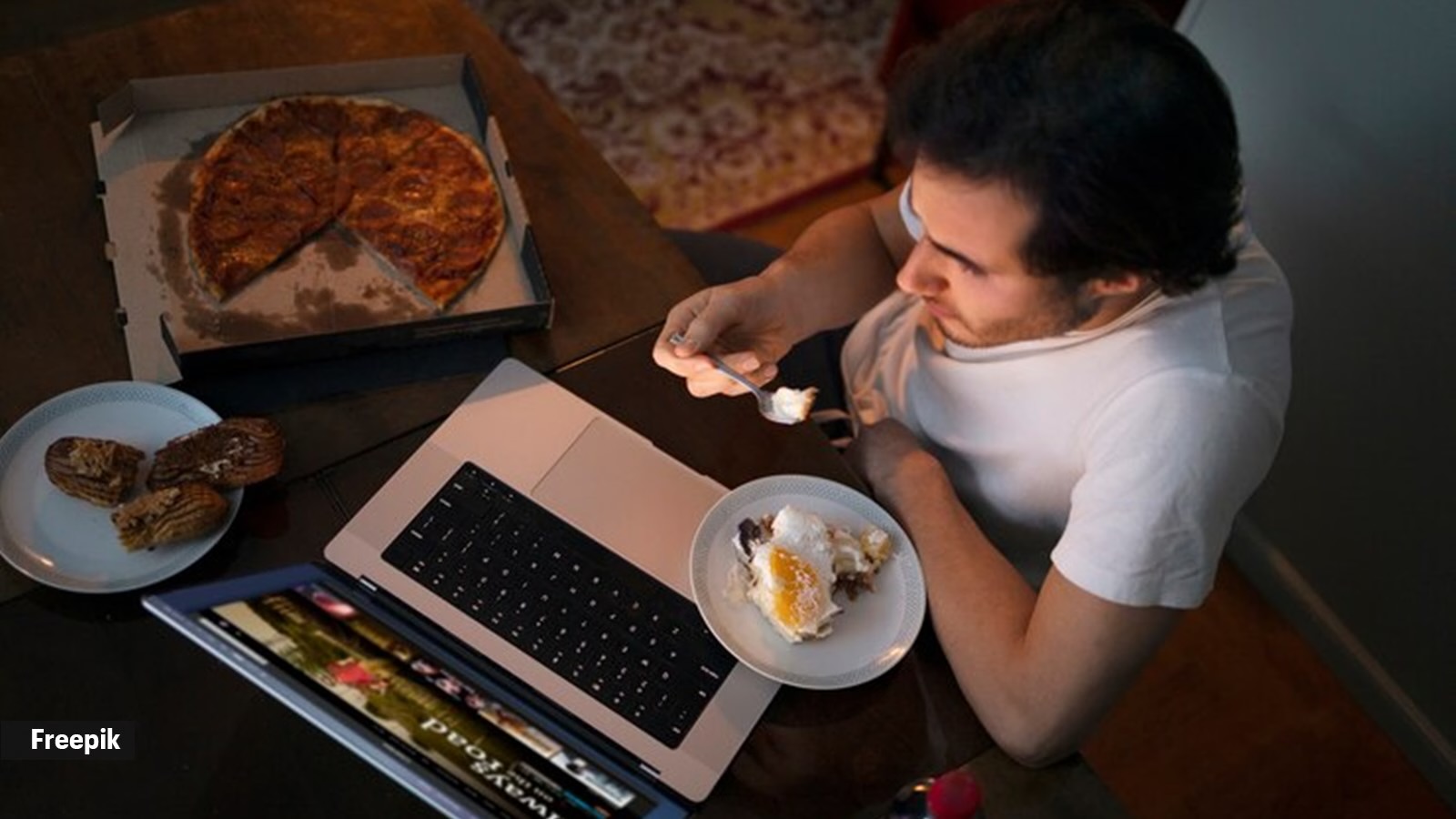
When you eat distracted, phone out, show on, half-present, your brain’s satiety system doesn’t close the loop. The meal memory never fully forms. The “I ate, I’m satisfied” signal gets filed under background noise.
So you finish the chips. And thirty minutes later, you’re looking for something else.
Not because your stomach is empty.
Because your mind is.
Here’s the moment it broke open for me.
One night, no phone, no TV, just food, I stopped halfway through my plate.
I was full.
Same portion. Same food. Genuinely full.
I had eaten that exact meal a hundred times in front of a screen and never once noticed the fullness until I’d pushed past it.
That night I just… landed in the meal.
And it was enough.
Here’s the wildest part of the research:
Distracted eaters don’t just eat more in the moment.
They eat more hours later, because the brain retroactively treats the earlier meal like it barely happened.
You can eat a full dinner and have your brain flag it as a light snack.
Because attention is what turns food into a meal.
Without it, you’re just loading fuel into a machine that didn’t log the transaction.
“I didn’t even enjoy it.”
You’ve thought this. Probably recently.
You ate something. The whole thing. And at the end, some part of you thought: that wasn’t even worth it.
That’s your brain catching up to what your attention missed.
You were there for the eating. But not the tasting. Not the satisfaction. Not the moment your body said okay, we’re good.
So the craving never resolved.
It just went quiet for a while.
The fix is almost embarrassingly small.
Not a diet. Not a meal plan. Not logging every calorie.
Just this:
First 5 bites. No screen. Full attention.
That’s it. The whole intervention.
Those five bites, actually tasted, actually registered, change the entire trajectory of the meal. Your brain gets enough signal to start building the memory. The loop starts to close.
You’ll eat less. Enjoy it more. And stop looking for something at 10pm that you can’t quite name.
Tools that quietly do the work for you
The goal isn’t to think more at meals. It’s to think less, because the right environment makes awareness automatic.
These two things made the biggest difference:
A plate that portions for you
I stopped eyeballing and started using a divided portion plate, specifically the Precise Portions 2-Compartment Plate.
Not because I was counting anything.
But because when the plate does the visual work, your brain stops multitasking between “how much is too much” and “am I actually tasting this.”
You just… eat. And somehow, that’s enough.
A one-minute pause you can actually feel
This sounds too simple to matter. It isn’t.
I put a Time Timer on the kitchen counter, the one with the shrinking red disc that shows you exactly how much time is left without making a sound.
Before I go back for seconds, I flip it to one minute.
Sometimes I’m back in the kitchen before it runs out.
But most of the time, I’m not.
That one minute is just long enough for your body to catch up to your brain. For the fullness signal to arrive. For the craving to reveal itself as habit instead of hunger.
Tonight, try one thing.
Don’t overhaul anything.
Just ask yourself, mid-meal: Do I actually remember the first bite?
If the answer is no, you already know what to do.
One last thing.
What’s a meal you actually remember enjoying recently?
Not just eating. Not just finishing. But genuinely tasting, savoring, being present for.
Hit reply and tell me. I read every one.
And if this landed differently than you expected, that’s the point.
I write about the health science that rewires how you think, not just what you do. Subscribe if you want more of it.
Disclosure: As an Amazon Associate, I may earn from qualifying purchases, but this does not affect my recommendations.I only suggest products I’ve personally vetted.


Leave a Reply