
Turns out boredom might be the most underrated weight loss hack nobody wants to admit works
A quick note from me: I really appreciate you checking out my blog! Just so you know, some of the links in this post are affiliate links. This means that if you buy something through them, I might earn a little bit of money, at no extra cost to you. There’s absolutely no pressure to buy anything, but if you do, it genuinely helps support the time and love I put into writing these posts.
Picture this. It’s 6:14pm. You’re standing in front of an open fridge, door alarm quietly beeping because you’ve been standing there too long, and you’re holding a jar of pickles like it might tell you what to make for dinner. It won’t. Nothing in that fridge is going to tell you anything, because you already decided forty-two other things today, what to wear, which email to answer first, whether that Slack message sounded passive-aggressive, and dinner is decision number forty-three, and your brain, quite reasonably, just clocks out. So you eat crackers standing up. Maybe some cheese straight from the bag. You tell yourself this is fine, this is just tonight, except it’s not just tonight, it’s basically every night, and somewhere underneath the crackers is this low hum of “why can’t I just get this one thing right.”
That hum has a name. It’s decision fatigue, and it’s not a character flaw, it’s just math. Every choice you make burns a little willpower, and by the time dinner rolls around, you’ve got fumes left in the tank, so your brain reaches for whatever requires zero thinking, which is almost never the thing that actually makes you feel good the next morning.
Here’s the part that sounds too simple to work, and yet. What if dinner just… stopped being a decision? Not because you’re depriving yourself, but because you already made the decision once, on a day when you had actual brainpower left, and now you’re just following through on a choice your smarter, less-exhausted self already made for you.
I know someone who did exactly this, almost by accident. She wasn’t trying to lose weight, she was just tired of the 6pm fridge-staring ritual, so she picked four dinners she genuinely liked and just… rotated through them. Same four, every week, for a month. She told me the first few days felt almost embarrassing, like she was cheating somehow, like real adults were supposed to be more creative than this. But by week two, she stopped thinking about dinner entirely. It just happened. And the weight loss wasn’t the plan, it was the byproduct of not white-knuckling her way through a decision she was too tired to make well.
That’s the part people miss. This isn’t about discipline. It’s about removing the exact moment where discipline is required to fail.
There’s a reason this works on a level deeper than logic, too. Your brain treats uncertainty as a low-grade threat. Every unplanned meal is a tiny unresolved question mark, and your nervous system doesn’t love question marks, it wants resolution, and if food doesn’t offer it, your brain will manufacture resolution some other way, usually by overeating something salty and crunchy until the tension goes down. Predictable meals close the loop before it ever opens. There’s nothing to resolve because there was never a question in the first place.
Now, repetition only stays sustainable if it’s actually effortless, because the second it becomes a chore, you’re right back to standing at that fridge. This is where a few unglamorous tools quietly do more work than any app or tracker ever could.
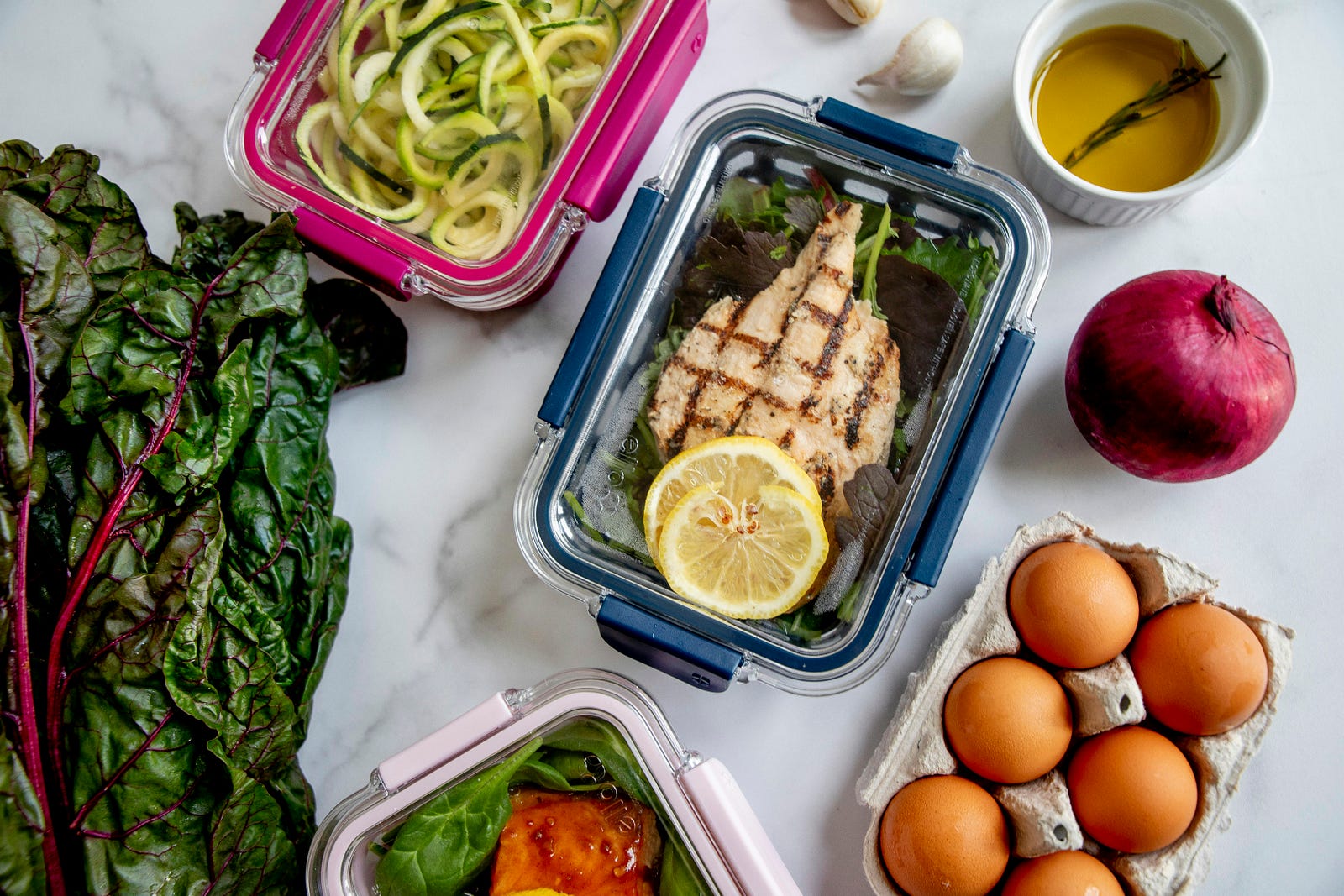
Start with stackable glass meal containers with snap lids, not because they’re exciting, but because when Sunday-you portions out four dinners in one sitting, Wednesday-you never has to make a single decision, just grab, heat, done. The container isn’t the win. Never having to think again is the win.
Pair that with a compact digital kitchen scale, because “eyeballing it” is how most people accidentally eat a third more than they think, and repetition only actually works if the meal stays consistent every time you make it, not just visually similar to last Tuesday’s version.
And for the mornings where even breakfast feels like too much to negotiate, a reusable shaker bottle with a built-in mixing ball turns breakfast into a fifteen-second event instead of a decision, so the very first choice of your day never has the chance to drain you before 8am.
None of these are exciting. That’s sort of the entire point. The stuff that actually works long-term rarely looks impressive from the outside, it just quietly removes friction until one day you realize you haven’t stood in front of an open fridge feeling lost in weeks.
So here’s my real question, and I actually want your answer, not just your agreement: if you had to lock in the exact same dinner, four nights a week, for the next month, what would you pick, and be honest, could you actually stick with it, or would you cave by Wednesday negotiating with yourself in a grocery store aisle?
Tell me in the comments, I read every single one, and I’ll probably steal the best answer for next week’s post. And if that fridge scene felt a little too familiar, that’s exactly the kind of thing I dig into here, the small daily stuff that quietly runs your life until someone names it out loud. Subscribe if you want more of that, because next week’s post is going to name a few more of them.

Subscribe on Medium and Substack
Disclosure: As an Amazon Associate, I may earn from qualifying purchases, but this does not affect my recommendations. I only suggest products I’ve personally vetted.


Leave a Reply